
Are we teaching children to learn, or are we teaching them to engage with screens?
The recent BBC coverage raising concerns about the amount of time primary school children are spending on educational maths apps, including TT Rockstars, has brought an important conversation back into focus.
Concerns were raised about children spending extended periods on the platform, with particular questions around its rewards, competition and whether it encourages children to prioritise the length of time spent online over the quality of learning taking place.
It is a conversation I think we need to have, and one that goes much further than simply asking whether children are spending too much time on screens.
As a parent coach with a first-class degree in psychology and a background in early years education, I am increasingly interested in what happens when we introduce young children to fast-paced, digitally driven approaches to learning, particularly when these begin to replace other valuable developmental experiences.
I'm not anti-technology. We live in a digital world, and children absolutely need opportunities to develop the skills to navigate it.
However, there is a difference between using technology purposefully to support learning and allowing it to become the default way children are taught, practised, motivated and rewarded.

My concern is that, in our enthusiasm to modernise education, we risk overlooking some of the fundamental things children need to develop into confident, capable and emotionally resilient learners.
And I think there are some particularly important considerations when we look at children who experience the world more intensely, including the Deep Feelers I work with.
1. Are educational apps teaching children that learning should be instant gratification?
One of the things that concerns me about heavily gamified educational apps is the way they package learning.
Points, coins, levels, leaderboards, virtual rewards and instant feedback can make an activity feel exciting. Children are encouraged to keep going, improve their score, unlock the next achievement and reach another level.
On the surface, this sounds like a great way to make learning enjoyable.
But what happens when children increasingly associate learning with this particular experience?
Learning doesn't always feel exciting. Sometimes it is repetitive, sometimes it is frustrating, sometimes it takes considerable effort to understand something, and sometimes we need to sit with uncertainty before something clicks.
These aren't problems we should always be trying to eliminate. They are important parts of learning.
Children need opportunities to develop persistence, tolerate frustration, work through mistakes and experience the satisfaction of understanding something that initially felt difficult.
If we continually make learning more stimulating through external rewards, immediate feedback and increasingly engaging digital experiences, I think we need to consider what this teaches children about the process of learning itself.
Do we risk creating an expectation that learning should always be fast, entertaining and rewarding?
What happens when they encounter something that doesn't offer instant gratification?
What about dopamine and reward pathways?
This is where the conversation about dopamine becomes relevant.
Dopamine is involved in motivation, reward learning and anticipating rewarding experiences. It plays an important role in how we learn and respond to rewarding experiences.
Many educational apps use reward mechanisms to encourage repeated engagement. Children might receive coins, points, badges or other incentives for completing activities, maintaining a streak or progressing through levels.
There is nothing inherently wrong with rewards, and we shouldn't suggest that using an educational app damages dopamine pathways or causes addiction. We don't have evidence to support that conclusion.
However, I think it is reasonable to ask how repeated exposure to highly rewarding digital environments might influence children's expectations around effort, motivation and gratification, particularly when their ability to regulate impulses is still developing.
We should be thinking about how we help children develop internal motivation, curiosity and a genuine enjoyment of learning, rather than relying too heavily on external rewards to keep them engaged.
Research into gamification in primary education is interesting here. A 2024 systematic review of 31 studies found that gamification could improve engagement, motivation and self-efficacy, but the findings around actual learning outcomes were mixed. The review also identified negative findings around collaboration.*
In other words, making learning more engaging doesn't automatically mean children are learning more effectively.
2. What does screen-based learning mean for children's developing brains?
Early childhood is a particularly important period of brain development.
Children are developing the foundations for executive functioning, including working memory, cognitive flexibility, attention regulation and inhibitory control.
These are the skills that help children pause before acting, manage distractions, shift between activities, hold information in mind, solve problems and regulate their responses.
They don't develop overnight. They develop gradually through experience, relationships, practice and opportunities to navigate everyday challenges.
This is where I think we need to be more thoughtful about the design and frequency of digital learning.
Many educational apps use features such as rapid feedback, changing visual stimuli, rewards and progression systems. Some encourage children to complete another activity, reach another level or improve their performance.
There is nothing inherently wrong with making an activity engaging. But we need to ask whether the way an app engages a child is supporting the type of attention and learning we actually want to develop.
There is a difference between being able to respond quickly to a series of questions on a screen and being able to concentrate on a complex task, think through a problem, manage frustration and persist when the answer isn't immediately obvious.
A 2024 systematic review and meta-analysis published in JAMA Pediatrics, involving 100 studies and more than 176,000 children, found associations between certain patterns of screen use and cognitive and psychosocial outcomes.
Importantly, the research highlighted that the context of screen use matters. Content, purpose, whether a child is using a device independently and whether an adult is involved can all make a difference.
A separate meta-analytic review published in Developmental Science in November 2025 examined the immediate effects of media exposure on children's attention and executive functioning. It found that the relationship was complex, with no consistent overall effect of media pace across studies.
This is important. We cannot simply conclude that fast-paced educational apps damage children's brains.
But neither should we assume that because an activity is labelled educational, it automatically supports every aspect of children's development.
We need to look beyond the screen and consider the experiences children are having alongside it.
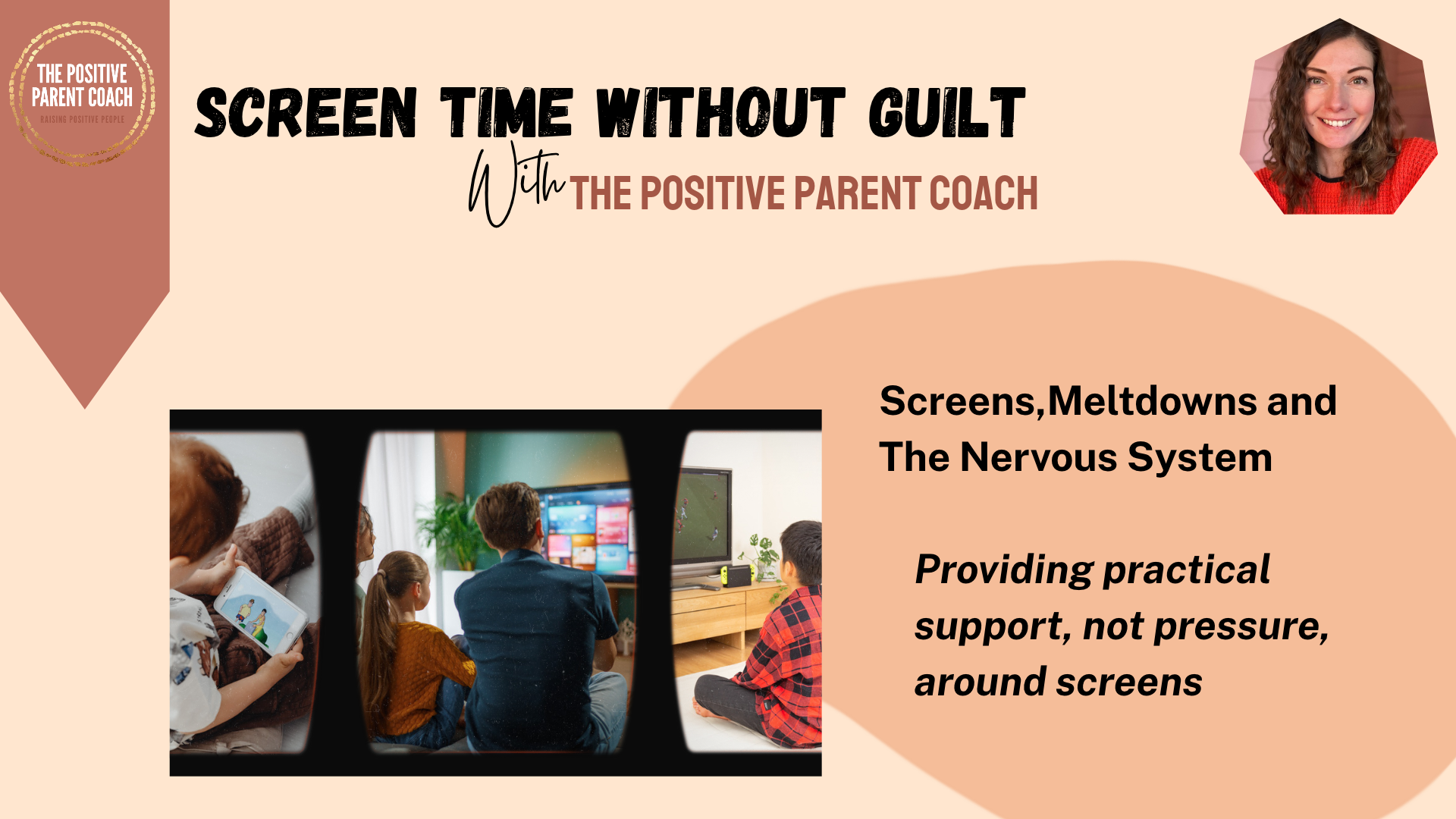
Full Access to my Screen Time Without Guilt Workshop can be found in The Parenting Solutions Studio
This Workshop highlights how device type, content, company etc all matter and how regulation fits into this.
3. Why executive functioning matters particularly for our Deep Feelers
This is an area I feel particularly strongly about because of the children I work with.
When I talk about Deep Feelers, I'm describing children who can experience the world intensely. They may have a strong need for certainty, become deeply absorbed in activities, experience frustration intensely, find transitions difficult or struggle when things don't go as expected.
These children aren't necessarily lacking executive functioning skills. They may have considerable strengths in some areas while finding particular demands more challenging.
However, supporting their developing executive functioning is incredibly important.
Executive functioning refers to the skills that help children manage their thoughts, feelings and behaviour.
There are four areas I think are particularly relevant:
Inhibitory control: The ability to pause, resist an impulse, wait, stop an activity and think before responding.
Cognitive flexibility: The ability to shift attention, adapt to changes, consider alternatives and move away from an idea or expectation.
Working memory: The ability to hold information in mind and use it while completing a task.
Emotional self-regulation: The developing ability to recognise, manage and recover from emotional responses.
Think about how often these skills are needed in everyday childhood.
When a child builds something and it falls down, they have an opportunity to manage frustration and try again.
When a game doesn't go their way, they can practise handling disappointment.
When they are playing with another child who has a different idea, they have an opportunity to practise flexibility, negotiation and compromise.
When they are deeply absorbed in an enjoyable activity and need to move on, they can practise managing that transition with the support of a trusted adult.
These experiences might not look like formal learning, but they are helping to build some of the foundations children need throughout their lives.
Now consider what happens when we increasingly introduce digital activities that offer immediate rewards, predictable progression and constant encouragement to continue.
For a child who already finds stopping difficult, becomes fixed on achieving a particular outcome or experiences perceived failure intensely, these features could create additional challenges around disengagement, frustration and emotional regulation.
This doesn't mean educational apps are inherently harmful, or that Deep Feelers should never use them.
It means we need to be thoughtful about the experiences we are providing and the skills we are helping children develop.
I would particularly like to see more emphasis on creating opportunities for children to practise executive functioning in everyday life, rather than assuming that academic engagement through a digital platform is enough.
We want to help our Deep Feelers develop the capacity to pause, adapt, tolerate uncertainty, manage disappointment and move through difficult feelings.
We don't develop these skills simply by avoiding difficult experiences. We develop them through supported opportunities to experience them, with adults alongside us who can provide the connection, guidance and co-regulation we need.
And that is something no educational app can fully replicate.
4. When learning becomes competitive: the impact of leaderboards and comparison
Another aspect that deserves attention is competition.
Some educational apps allow children to compare their performance with classmates through leaderboards, scores and rankings.
For some children, this might be motivating. They enjoy a challenge, like seeing their progress and find competition exciting.
But children are not all motivated in the same way.
For a child who is already anxious about getting things wrong, struggles with confidence or finds comparison difficult, seeing where they sit in relation to their peers could create additional pressure.
Imagine being a young child who is still developing confidence in maths, only to see that other children are completing more questions, earning more points or progressing through levels more quickly.
What might that communicate?
That they aren't as good? That they are falling behind? That other children are more capable?
We know that children can attach considerable meaning to how they compare themselves with others, particularly in environments where achievement is made visible.

For children who are deeply feeling, sensitive to perceived failure or prone to perfectionism, this can be particularly challenging.
I would much rather see children encouraged to recognise their own progress, understand their individual learning journey and develop confidence in their abilities without constantly being positioned against their peers.
There is a difference between healthy encouragement and creating an environment where children feel they must continually prove themselves.
We also need to remember that children develop at different rates. A leaderboard doesn't tell us about the effort someone has made, the understanding they have developed or the individual challenges they might be navigating.
5. Are we measuring time spent learning rather than actual understanding?
This is perhaps one of my biggest concerns.
When children are given online learning targets, points to earn or activities to complete, how much attention is being paid to what they have actually understood?
A child might spend twenty minutes answering questions on a maths app, earn plenty of points and progress through several levels.
But can they explain the mathematical concept?
Can they apply what they have learned to a different problem?
Do they understand why the answer is correct?
Can they use that knowledge outside the app?
Completing more questions doesn't necessarily mean deeper learning has taken place.
Speed and accuracy have their place, particularly when children are developing fluency with number facts. But fluency is not the same as understanding.
The Education Endowment Foundation (EEF) highlights the importance of using physical manipulatives and representations to help children develop mathematical understanding.
This might involve using counters, blocks, objects, drawings, number lines or even their fingers.
These approaches allow children to physically explore mathematical concepts, make connections, explain their thinking and develop a deeper understanding of what numbers represent.
A child who is physically moving counters to understand addition is engaging with the concept in a very different way from a child repeatedly selecting answers on a screen.
Both approaches might have a place. But one should not automatically replace the other.
We need to be careful that we don't confuse visible activity with meaningful learning.
6. What are children missing when learning increasingly happens on screens?
Perhaps the biggest question is not simply what children are doing on educational apps, but what they might not be doing instead.
Child development doesn't happen exclusively in a classroom or through structured educational activities.
It happens when children are playing outside, building dens, climbing, exploring, asking questions, making mistakes, negotiating with friends, creating imaginary worlds and discovering how things work.
It happens through conversations, shared experiences, reading stories, playing board games, building with blocks, cooking, gardening and exploring the world around them.
These experiences support far more than academic learning.
They provide opportunities to develop language, social understanding, problem-solving, creativity, coordination, emotional regulation and independence.
Consider the difference between learning about measurement through an online activity and helping to measure ingredients while baking.
Or practising number recognition on a tablet compared with counting stones, collecting leaves, building towers or playing a board game.
Both can introduce mathematical concepts, but the real-world experience brings movement, sensory feedback, communication, problem-solving and connection into the learning process.
The World Health Organization recognises the importance of balancing sedentary screen activities with physical activity, sleep and other developmental needs in its guidance for children under five.
The UK Chief Medical Officers also highlight the importance of physical activity and reducing prolonged sedentary behaviour throughout childhood.
This isn't about suggesting that every minute spent on a screen is a minute wasted.
It is about recognising that children's days have limits. Time spent doing one thing inevitably reduces the time available for something else.
And we need to think carefully about what those experiences are.
7. The digital world, algorithms and the messages children are receiving is another conversation here that I don't think we can ignore.
Children are growing up in an increasingly algorithm-driven world.
Many digital platforms use algorithms to personalise experiences, recommend content, respond to engagement and influence what users see next.
Not all algorithms have the same purpose. For example, an educational app might use an adaptive algorithm to identify which maths questions a child needs to practise. This can be genuinely useful.
But other digital environments are designed around keeping users engaged, encouraging repeated interaction and increasing the amount of time they spend on a platform.
We need to understand the distinction.
We also need to think about the messages children are receiving about how digital experiences work.
Older children can gradually be supported to understand why platforms recommend certain content, how online environments influence behaviour and why they might be encouraged to keep clicking, watching or playing.
But what about younger children?
Can we realistically expect a five or six-year-old to understand the motivations behind digital design, the role of algorithms or why certain rewards are being offered?
They are still developing the ability to recognise and manage their own impulses. This makes the responsibility for thoughtful digital design and appropriate boundaries even more important.
I don't think we should wait until children are older to start thinking about digital literacy. But we also shouldn't expect young children to have the developmental capacity to manage digital environments independently.
We need to be teaching children about technology while also recognising that the responsibility for creating appropriate digital environments rests with adults, educators and technology providers.
8. What message are we giving parents?
There is one final issue that I think deserves more attention.
Parents are regularly encouraged to limit screen time, get children outside, encourage imaginative play, promote reading, support real-world friendships and create opportunities for connection.
These are all important messages.
But what happens when schools are simultaneously encouraging children to spend more time on educational apps, complete online learning activities and engage with digital platforms outside the classroom?
It can create a difficult contradiction for parents.
How are we supposed to encourage children to switch off, enjoy alternative activities and develop a balanced relationship with technology when screen-based learning is increasingly becoming part of their educational expectations?
And what happens when a child is already finding it difficult to disengage from a device, only to be told that they need to spend more time on it to complete their learning?
We need a joined-up approach.
Schools, parents and technology providers all have a role to play in helping children develop a healthy relationship with technology.
We cannot simply tell parents to manage screen time more effectively without also examining the digital expectations being placed on children throughout their school day.
9. I'm not against technology. I'm advocating for balance.
I want to be really clear about this.
Technology has an important place in modern education.
It can make information more accessible, support children with additional learning needs, provide useful opportunities for practice and help teachers identify areas where children need additional support.
For some neurodivergent children, carefully selected digital tools can also reduce barriers to learning and provide an alternative way to engage with information.
There are genuine benefits.
But technology should support good teaching, not become a substitute for it.
It should complement opportunities for movement, play, conversation, exploration and hands-on learning, rather than gradually pushing them aside.
And we need to be asking better questions about the digital tools we introduce into children's lives.
Not simply:
Is the app engaging?
Are children enjoying it?
How many questions are they completing?
How long are they spending on it?
But:
Is it actually improving their understanding?
Is it supporting meaningful learning?
Is it encouraging curiosity and independent thinking?
Does it support children's developing attention and self-regulation?
Does it create unnecessary pressure or comparison?
What opportunities might it be replacing?
Is the amount of time being spent on it proportionate to its educational value?
These are the questions I would like to see at the centre of conversations about educational technology.
Children need more than digital learning
Ultimately, childhood is about so much more than academic achievement.
Children need time to play, explore, connect, move, make mistakes, develop relationships and discover the world around them.
They need opportunities to learn that not everything is immediate, that effort doesn't always produce an instant reward, that getting something wrong is part of learning and that their worth isn't measured by how quickly they can complete a task or how they compare with someone else.
We are raising children in a digital world, and we have a responsibility to prepare them for that world.
But preparing children for the future shouldn't mean rushing them through the experiences that are fundamental to their development in the present.
I don't want us to look back in ten or fifteen years and realise that, in our enthusiasm to modernise education, we overlooked the importance of the very things that help children develop into confident, capable, resilient and connected individuals.
Technology has a place.
But so does getting outside, playing with friends, building something, reading a book, asking questions, exploring, making mistakes and learning alongside another human being.
Perhaps the question isn't whether technology belongs in children's education. It's whether we are giving it more space than it deserves.
And I think that's a conversation worth having.
About Olivia Edwards
Olivia Edwards is The Positive Parent Coach, a trauma-informed parenting coach with a first-class degree in psychology and a background in early years education. She supports parents to better understand their children's behaviour, emotional needs and development, with a particular focus on children she describes as Deep Feelers.
Research and References
1. BBC News – Children spending too long on maths app, MP warns (November 2026). The recent discussion around TT Rockstars, rewards, competition and time spent on educational apps. Related BBC coverage.
2. Romero-Rodríguez et al. (2024). The reality of the gamification methodology in Primary Education: A systematic review. International Journal of Educational Research. Read the research.
3. Mallawaarachchi et al. (2024). Early Childhood Screen Use Contexts and Cognitive and Psychosocial Outcomes: A Systematic Review and Meta-analysis. JAMA Pediatrics. Read the research.
4. Hinten, Scarf and Imuta (2025). Meta-Analytic Review of the Short-Term Effects of Media Exposure on Children's Attention and Executive Functions. Developmental Science. Read the research.
5. Education Endowment Foundation. Using Manipulatives and Representations to Develop Understanding. Read the guidance.
6. World Health Organization (2019). Guidelines on Physical Activity, Sedentary Behaviour and Sleep for Children Under 5 Years of Age. Read the guidance.