
The Screen Time Battle: Why Taking the Tablet Away Isn't Solving the Problem
Struggling with screen time battles, meltdowns when the tablet goes off, or a child who simply won't stop watching? Here's why screen time can become such a flashpoint, and what you can do to make things easier for both of you.
“Five more minutes.”
“Just let me finish this bit.”
“But I haven't finished!”
You give a warning. Then another. You remind your child that you've already discussed the rules. Perhaps you try reasoning with them, offering a compromise or promising that they can have the tablet again tomorrow.
And then, eventually, you've had enough. The tablet goes off. Your child explodes.
Suddenly, you're dealing with shouting, tears, accusations that you're the worst parent ever, or a child who refuses to move, listen or do anything you ask.
And you're left wondering how something as simple as turning off a screen can create so much conflict.
If this sounds familiar, you're certainly not the only parent experiencing it.
Screen time battles are a common source of frustration for families. And when they happen day after day, it's easy to start questioning whether you're being too soft, whether your child has too much screen time, or whether you simply need to get better at holding boundaries.
But there's something important I'd like you to consider.
What if the problem isn't simply that your child doesn't want to stop watching? What if there's more going on beneath the behaviour than you can see?
Understanding that difference can change how you approach screen time, and perhaps a whole lot of other parenting challenges, too.

Why is Screen Time so difficult for children to stop
Screens can be incredibly absorbing.
Whether your child is playing a game, watching videos or following their favourite characters, there's often a constant stream of stimulation, novelty and reward. There's always something else to watch, another level to reach or another video to click on.
For some children, particularly those who find everyday life demanding, screens can also offer something else: a predictable, enjoyable space where they feel competent, in control or able to switch off from the demands around them.
Now imagine being completely absorbed in something you enjoy, only to be told that you need to stop immediately and move on to something else.
As adults, we don't always find that easy ourselves.
For children, the shift can be even harder. Their ability to manage frustration, regulate emotions, shift attention and cope with disappointment is still developing.
And some children find these things much harder than others.
This doesn't mean that children should be allowed unlimited screen time, or that every meltdown is inevitable. It means that understanding why stopping is difficult can help us choose a response that's more likely to work.
1. Knowing the rule doesn't mean your child can manage the moment
You might have explained your screen time rules perfectly.
Your child knows that they have 30 minutes on the tablet. They know that when the timer goes off, it's time to stop. They might even be able to tell you exactly what will happen if they refuse.
And yet, when the moment arrives, everything falls apart.
This is where we can get caught in a frustrating cycle.
We assume that because our child understands the rule, they should be able to follow it. When they don't, we repeat ourselves, increase the consequences or assume they're deliberately pushing our buttons.
But knowing what to do and having the capacity to do it in a particular moment are two different things.
A child can understand that screen time is ending and still struggle to manage the disappointment, shift their attention or cope with the demand to move on.
This is particularly important for children who experience big emotions, struggle with transitions, have sensory differences or find flexibility and changes in routine difficult.
The expectation might be reasonable. The boundary might be entirely appropriate. But your child may still need support to manage what that boundary brings up for them.
Instead of asking only, “Why won't they listen?”, try asking yourself, “What is making this difficult for them right now, and what might help?”
That question doesn't mean removing the expectation. It helps you work out how to support your child in meeting it.
2. Taking the screen away doesn't teach the skill your child is missing
When screen time ends in a meltdown, it's understandable to focus on stopping the behaviour.
You might remove the tablet, cancel the next opportunity to watch something or introduce a stricter screen time routine.
Sometimes, a clear consequence is appropriate. Children do need boundaries, and parents don't need to negotiate every limit. But if your child repeatedly struggles to stop, it's worth considering what they're actually learning from the experience.
Are they developing the ability to manage disappointment, shift attention and move between activities? Or are they simply experiencing another moment of overwhelm, followed by a confrontation with you?
There is a difference between stopping a behaviour in the moment and helping a child develop the skills they need to manage similar situations in the future.
When we're focused entirely on compliance, we can miss the opportunity to help our children practise those skills.
That might mean helping them anticipate the end of screen time, supporting them through the transition, giving them a meaningful choice about what happens next, or gradually building their ability to stop without becoming overwhelmed.
It also means recognising that children don't learn to manage big feelings simply because we tell them to.
They learn through repeated experiences, with support, boundaries and opportunities to practise.
3. Sometimes, the screen is meeting a need
This is something I encourage parents to get curious about.
What does your child get from screen time?
Of course, it might simply be fun. And there's nothing inherently wrong with children enjoying games, videos or their favourite programmes. But for some children, screens also provide a break from the things they find difficult.
Perhaps your child spends the school day managing expectations, navigating friendships, coping with noise and concentrating on things that don't come easily.
Perhaps they find social interaction exhausting, struggle with uncertainty or spend much of their day trying to keep themselves together.
When they get home, the tablet might offer predictability, control, comfort or a chance to switch off.
For another child, gaming might be a place where they feel capable and successful, particularly if they spend much of their day feeling that things are difficult.
This doesn't mean that screens are the only way to meet those needs, or that every child who struggles with screen time is overwhelmed or neurodivergent.
It means that if screen time is providing something important for your child, simply removing it might not address what they're seeking from it.
It can be helpful to ask yourself:
Is my child using screens to unwind after a demanding day?
Do they find it difficult to move away from activities they enjoy?
Are there other times of day when they struggle with frustration, changes or demands?
What else helps them feel calm, capable, connected or in control?
These questions can help you understand the bigger picture and work out what support might make a difference.
4. Your child's reaction may be telling you something about transitions
One of the most useful things to notice is whether screen time is the only situation that causes this level of difficulty.
Does your child also struggle when it's time to leave the park, get dressed, stop playing, come to dinner or leave a friend's house?
Do seemingly small changes lead to disproportionately big reactions?
If so, the difficulty might not be exclusively about screens. Your child may find transitions particularly challenging.
Moving from one activity to another involves shifting attention, letting go of something we're enjoying, managing uncertainty and directing ourselves towards something different.
For some children, those demands are much harder than they appear from the outside.
This can be especially true for children who are sensitive to change, experience big emotions, or have difficulties with flexibility and executive functioning.
If this sounds like your child, it may be helpful to explore my page on what it means to be a Deep Feeler. I use the term Deep Feeler to describe children who experience the world intensely and may need a different kind of support to navigate their emotions, relationships and everyday demands.
It isn't a diagnosis, and it won't describe every child who struggles with screen time. But understanding your child's individual temperament and needs can help you make sense of patterns that otherwise feel confusing.
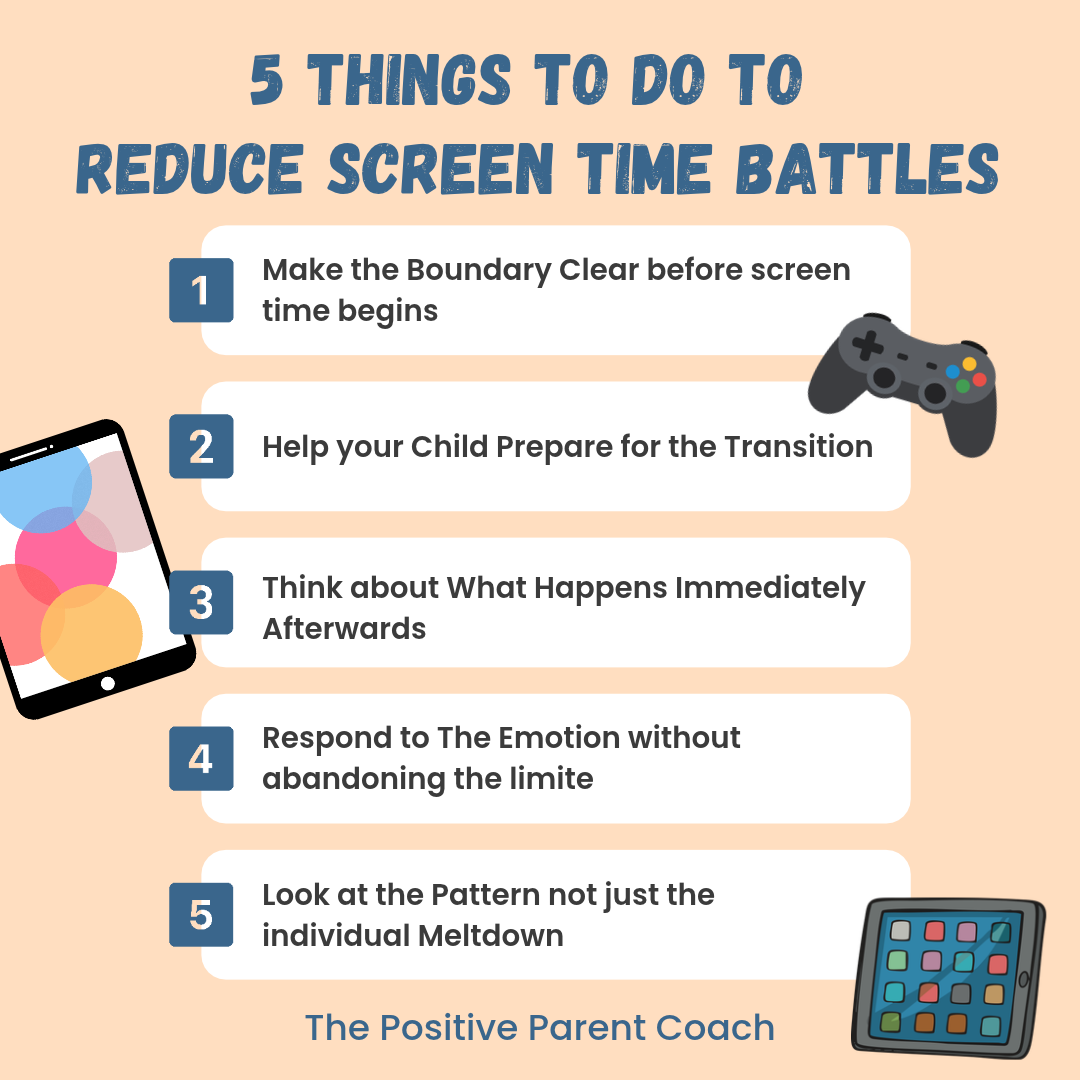
So, how can you reduce screen time battles?
Understanding the reasons behind your child's behaviour is important. But I also know that you need practical strategies for the next time the tablet needs to go off.
Here are 5 things to try…
1. Make the boundary clear before screen time begins
It's much easier to establish expectations before your child is absorbed in an activity than to introduce them when it's time to stop.
Agree on how long screen time will last, what will happen when it ends and what comes next.
Where possible, involve your child in creating a routine that works for your family.
You might say: “After tea, you can have 30 minutes on your tablet. When the timer finishes, we'll put it away and get ready for bed.”
The aim isn't to create a lengthy negotiation every time. It's to make the boundary predictable so that your child knows what to expect.
You can be warm and flexible about how you support your child while remaining clear about the limit itself.
2. Help your child prepare for the transition
A sudden demand to stop can be difficult, particularly when your child is deeply engaged.
Try giving a reminder before screen time ends, followed by a clear signal when it's time to stop.
For some children, a visual timer can be helpful. Others might benefit from knowing when a particular level, episode or agreed stopping point is approaching, provided that this fits within the boundary you've set.
Notice what works for your child rather than assuming that more warnings will always help. Some children find repeated reminders reassuring; others become more anxious or frustrated as the ending approaches.
The goal is to make the transition easier to anticipate, not to give endless opportunities to delay it.
3. Think about what happens immediately afterwards
Sometimes, we're so focused on ending screen time that we haven't considered what we're asking our child to do next.
Are they moving straight from a highly stimulating activity to homework? Are they being asked to stop something enjoyable and immediately complete several tasks?
This doesn't mean you need to make every transition exciting or reward your child for complying.
It means thinking about the demands involved and whether you can make the next step more manageable.
Perhaps your child needs a few minutes to decompress, some connection with you, a snack, movement or a clear first step.
You might say: “I know it's hard to stop when you're enjoying yourself. The tablet is finished now. Would you like to come and help me make a snack, or have a few minutes to sit with me first?”
The boundary remains in place. You're simply helping your child move towards what comes next.
4. Respond to the emotion without abandoning the limit
This is often the hardest part, especially when your child's reaction is loud, intense or relentless.
You can acknowledge how your child feels without changing your decision; “I know you really wanted to keep playing. It's frustrating when something fun has to end. Screen time is finished for today.”
You don't need to convince your child that the boundary is fair, make them happy about it or eliminate their disappointment.
They are allowed to feel cross. They are allowed to be disappointed.
Your role is to hold the boundary and help them navigate the feeling, rather than getting drawn into an argument about whether they're allowed to have it.
And if your child is too overwhelmed to listen to explanations, you don't need to keep talking. Sometimes, fewer words, a calm presence and a little time are more helpful than another attempt to reason with them.
Being empathetic doesn't mean being permissive. You can understand your child's feelings and still mean what you say.
5. Look at the pattern, not just the individual meltdown
If screen time battles happen regularly, it's worth stepping back and noticing what tends to happen before, during and after them.
Does it happen more often when your child is tired, hungry or already overwhelmed? Are certain games or videos particularly difficult to stop? Is the transition harder at particular times of day?
You might also notice whether the same difficulties appear in other areas of family life.
This can help you distinguish between a screen time routine that needs adjusting and a wider difficulty with emotional regulation, attention, autonomy or transitions.
You don't need to solve everything at once. Start by noticing the pattern and identifying one change that might make the situation easier.
What if you've tried all of this and screen time is still a battle?
I want to acknowledge something here.
You might have read all the advice, tried the timers, introduced clear boundaries and practised staying calm.
You might understand why your child finds things difficult and still feel completely exhausted by the daily arguments.
That doesn't mean you've failed. And it doesn't necessarily mean your child needs even stricter rules or that you need to become a more patient parent.
Sometimes, the difficulty is that we're trying to solve a complex problem with a strategy that addresses only one part of it.
Screen time might be the most obvious flashpoint, but perhaps your child also struggles with getting dressed, following instructions, coping with disappointment, leaving the house or managing the demands of everyday life.
Perhaps you're constantly trying to work out whether to hold the boundary, offer support, step back or step in.
This is where looking at the bigger picture can make a real difference.
In my work as The Positive Parent Coach, I help parents understand the reasons behind their child's behaviour, recognise what might be making everyday demands difficult and find practical ways to support their child while maintaining clear boundaries.
My approach is trauma-informed and rooted in understanding children's emotional needs, development and individual differences. It's not about letting children do whatever they want, nor is it about finding the perfect consequence to make them comply.
It's about understanding what is happening beneath the behaviour, so that we can respond in ways that support both our children's development and our relationship with them.
Because the goal isn't simply to get your child to turn off the tablet without an argument.
It's to help them gradually develop the skills they need to navigate frustration, change and the many demands of everyday life, while making family life feel more manageable for you, too.
It's not about saying screens are bad
I want to be clear about something. This isn't me saying that screens are bad, that children shouldn't enjoy them, or that the answer is to remove them altogether.
Screens are part of modern family life, and they can offer entertainment, creativity, learning and connection. I don't believe parenting needs to be about feeling guilty every time your child watches a programme or plays a game.
But I do believe that the type of content, the device being used and how children engage with screens really matter.
There is a difference between watching a carefully chosen programme together, creating something, playing an age-appropriate game and spending long periods moving between highly stimulating videos that never seem to end.
It's also worth thinking about why your child is reaching for a screen.
If screens have become your child's main way of managing difficult feelings, switching off from overwhelm or recovering after a demanding day, simply reducing their screen time might not address the underlying need. It can be helpful to think about what the screen is providing for them, alongside how to build other ways for them to regulate, unwind and feel good.
This is one of the reasons I created my Screen Time Workshop. I wanted to help parents move beyond the question of “How much screen time is too much?” and think more carefully about the content their children consume, the way they use devices and the role screens play in family life.
If you'd like to explore this further, you can access my Screen Time Workshop, along with the accompanying resources and my whole library of expert workshops and practical parenting resources, through The Parenting Solutions Studio.
With a yearly subscription, it works out at less than £9 a month, with no hidden fees and the freedom to leave whenever you choose.
It's a place to build your understanding of your child, explore the reasons behind challenging behaviour and find practical ideas to help everyday family life feel more manageable.
A Final Thought
The next time your child has a meltdown when screen time ends, it's okay to hold the boundary.
You don't need to hand the tablet back, negotiate for another ten minutes or pretend that the behaviour is acceptable.
But alongside asking, “How do I stop this happening?”, try asking a different question:
“What is making this so difficult for my child, and what do they need to learn or develop to manage it differently?”
That shift won't make every screen time battle disappear overnight. But it can help you move away from the same argument on repeat and towards understanding what's really happening for your child.
And often, that's where more effective parenting strategies begin.
Want help understanding your child's behaviour?
If you're finding that screen time is just one of many daily battles, I'd love to help you explore what's happening beneath the surface.
Explore Parenting Solutions Studio, where you'll find practical guidance and support to help you understand your child's behaviour and make everyday family life feel more manageable.
Discover Parenting Solutions Studio
And if your child experiences big emotions, struggles with transitions or seems to feel everything intensely, you might also like to explore:
Understanding your child differently can be the first step towards doing things differently, too.
Olivia Edwards is The Positive Parent Coach, a trauma-informed parent coach and former Early Years teacher. She supports parents of children with big emotions, strong wills and individual needs to understand behaviour, build connection and develop practical strategies that work for their family.