
The Clocks Go Back This Weekend: How to Help Your Child Adjust
The clocks go back this Sunday, and while an extra hour in bed might sound wonderful, you might find that your children's body clocks haven't quite got the memo!
If you have a little one who usually wakes at 6am, you might suddenly find yourself welcoming them into your bedroom at 5am instead.
You might notice your toddler becoming tired earlier in the evening, your school aged child getting more emotional after school, or your child who already struggles with transitions finding the change to their routine a little harder.
So, how does the clock change affect children's sleep and behaviour? And what can you do to help your child adjust over the next few days?
Let's take a look.

When do the clocks go back in the UK in 2026?
In the UK, the clocks go back by one hour at 2am on Sunday 25 October 2026. The time changes from 2am to 1am, and we return to Greenwich Mean Time (GMT).
Although we gain an extra hour overnight, our body clocks don't automatically adjust at the same time.
Our bodies have an internal rhythm that helps regulate when we feel awake, sleepy and ready for rest. Light, darkness and our usual routines all help to keep this rhythm on track.
When the clocks change, the time on the clock suddenly looks different, but your child's body might still be working to its previous schedule.
This is why some children wake earlier than usual, feel tired at different times or take a little while to settle into their usual bedtime routine.
Every child is different, though. Some barely notice the change, while others need a little more time and support to adjust.
How does the clock change affect children's sleep and behaviour?
The most obvious effect of the clocks going back is often a change in sleep patterns.
Your child might wake earlier, struggle to fall asleep at their usual bedtime or seem ready for a nap at a different time.
However, the effects aren't always limited to sleep. When children are tired, they may find it harder to manage frustration, cope with disappointment, concentrate or move between activities.
You might notice that your child:
Wakes earlier than usual in the morning.
Seems tired much earlier in the evening.
Takes longer to settle at bedtime.
Becomes more irritable or emotional.
Has less patience with siblings.
Finds getting dressed or leaving the house more difficult.
Needs more reassurance or support with everyday tasks.
Has bigger emotional reactions towards the end of the day.
Of course, these things can happen for lots of reasons, and not every change in behaviour will be related to sleep.
But if your child seems to be finding things harder around the time the clocks change, tiredness and disruption to their usual routine are worth considering.
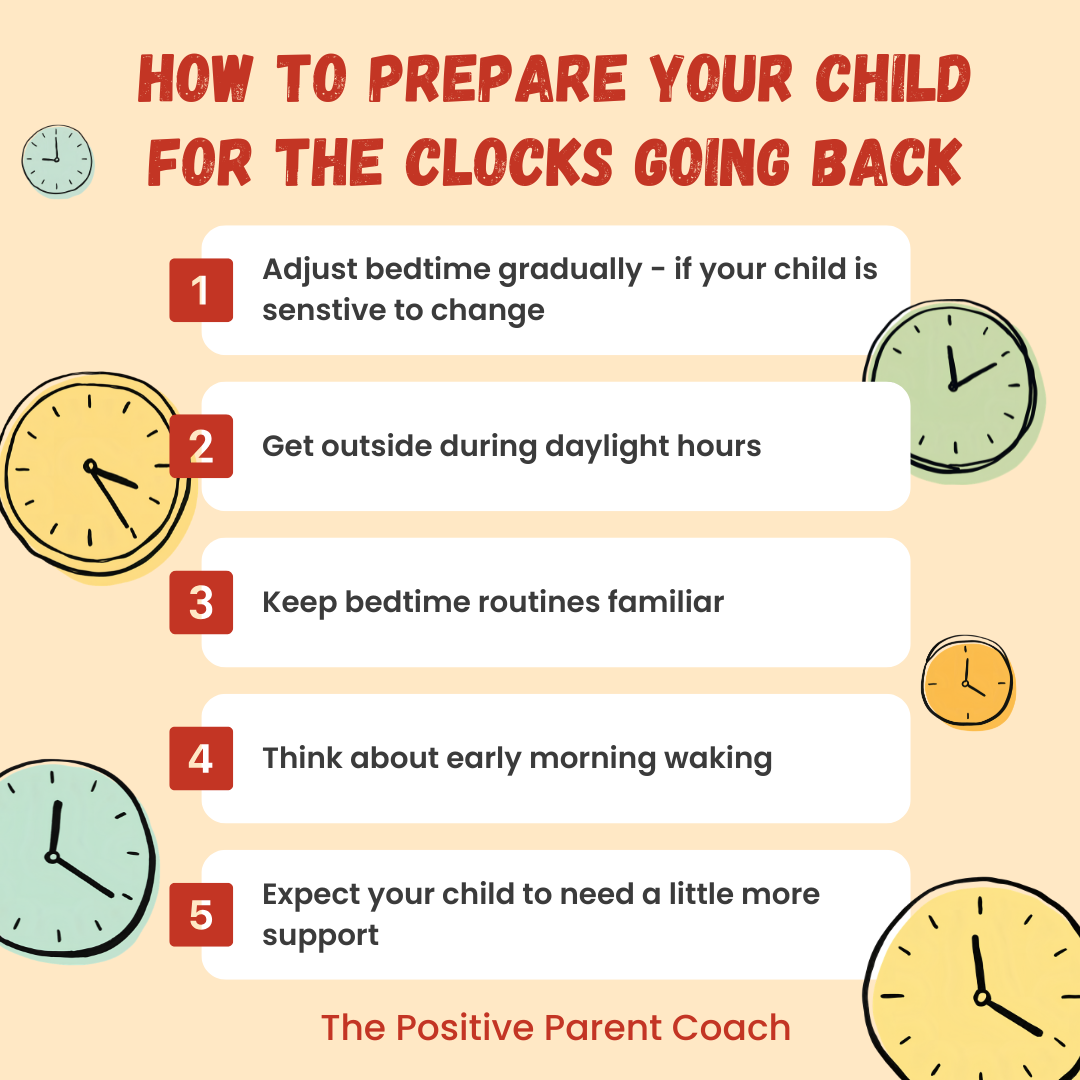
How to prepare your child for the clocks going back
There are a few simple things you can do to help your child adjust to the time change.
You don't need to do everything on this list. Choose the approaches that suit your child, their sleep patterns and what feels manageable for your family.
1. Adjust bedtime gradually if your child is sensitive to change
Some families prefer to keep their usual routine and allow their child's body clock to adjust naturally.
Others find it helpful to make small changes to bedtime, meals and naps over several days.
If your child is particularly sensitive to changes in routine, you could try shifting their schedule gradually, by around 10–15 minutes at a time, rather than making a sudden one-hour adjustment.
For the autumn clock change, this generally means moving the routine a little later according to the old clock time, so that it feels closer to the usual time once the clocks go back.
For example, if your child normally goes to bed at 7pm, you could gradually move bedtime later over the days before the change.
You can adjust meals and naps in the same way if that suits your child's age and sleep needs.
This approach won't guarantee that your child sleeps later, but it may make the transition easier for some children.
If you've left it until the weekend, don't worry. You haven't missed your chance to help your child adjust. You can keep things familiar and make small adjustments over the following days instead.
2. Get outside during daylight hours
Natural light helps regulate our body clock, so try to make the most of daylight during the day.
This doesn't need to involve a big outing.
A walk to school, a trip to the park, playing in the garden or collecting leaves on the way home can all provide opportunities to get outside.
With the evenings becoming darker earlier, getting outside during daylight hours can be particularly helpful.
3. Keep bedtime routines familiar
When sleep timings feel a little different, familiar routines can help children understand what comes next.
Where possible, keep the usual bath, pyjamas, story and cuddle.
If your child seems tired earlier than usual, you may need to adjust bedtime temporarily rather than insisting they stay awake until their usual time.
If they aren't ready to sleep at their usual bedtime, try to keep the evening calm and predictable while their body clock adjusts.
And remember that a few unsettled evenings don't mean you've ruined your child's sleep routine.
4. Think about early morning waking
If your child starts waking earlier after the clocks go back, it can be tempting to start the day straight away.
Where practical, try to keep early mornings quiet and relatively dark until you're ready for the day to begin. You can then open the curtains and get some natural light once it's time to get up.
Blackout blinds may also help if early morning light is contributing to your child's waking.
Try to maintain a consistent morning routine, while recognising that your child may need a little time to adjust.
5. Expect your child to need a little more support
This is particularly important if your child already struggles with emotional regulation.
When children are tired, they can find it harder to manage frustration, cope with disappointment and move between activities.
You might notice more resistance around getting dressed, leaving the house, eating dinner or getting ready for bed.
Rather than immediately assuming that your child is being difficult, consider whether tiredness or a disrupted routine might be contributing.
They may need a little more help, a little more connection and slightly fewer demands while they adjust.
You don't need to remove every boundary or expectation. But you might need to offer more support to help your child manage them.

How the clocks going back can affect toddlers and preschoolers
If you have a baby, toddler or preschooler, the autumn clock change can bring a familiar challenge: early morning waking.
Your child who usually wakes at 6.30am might suddenly be ready to start their day at 5.30am. Their body hasn't necessarily decided it wants an earlier start. It's simply still following its previous rhythm.
You might also notice that your toddler is ready for a nap earlier, seems tired before their usual bedtime or asks for food at different times.
If your child is already an early riser, I appreciate that the thought of an even earlier start might not fill you with joy!
Try to keep your child's routine as consistent as possible while allowing some flexibility around sleepiness, naps and meals.
If they seem particularly tired, they may need an earlier bedtime for a few days. If they're not ready to sleep at their usual time, keeping the evening calm and predictable can help.
You don't have to get every timing exactly right. The aim is to help your child settle into the new rhythm without creating unnecessary pressure for either of you.
How the clocks going back can affect older children
With older children, the changes might look a little different.
They might not wake up an hour earlier and announce themselves at the crack of dawn. Instead, you might notice that they're more tired after school, less patient with siblings or more easily frustrated by things that wouldn't usually bother them.
You might also find that they struggle to switch off in the evening, particularly if they're used to having more daylight after school.
For children who are already managing a lot, the combination of school demands, homework, friendships and after-school activities can make the end of the day feel particularly difficult.
Here are three things that may help.
Protect their downtime after school. If your child has spent the day listening, concentrating, navigating friendships and managing school expectations, they might need some time to decompress when they get home.
Try to avoid immediately filling the afternoon with instructions, homework, chores and activities if you can help it.
Keep evenings predictable. A familiar wind-down routine, reading, listening to music or doing something quiet together can help signal that the day is coming to an end. If your child uses screens in the evening, try to maintain a predictable routine that includes some time away from screens before bed.
Get as much daylight as you can. Look for opportunities to get outside before school, at lunchtime or during the weekend.
And if bedtime or getting ready for school becomes more challenging for a few days, try to approach it with curiosity rather than immediately turning it into another battle.

What if your child is neurodivergent or struggles with transitions?
For some children, changes to familiar routines can feel much bigger than we might expect. If your child is autistic, has ADHD, experiences sensory sensitivities or finds transitions difficult, the clock change might be one more thing they need to adapt to.
They may find it harder to understand why they're expected to go to bed when they don't feel tired, or why it's dark when they're usually playing outside.
They might also be more sensitive to the knock-on effects of disrupted sleep. If this sounds like your child, there are a few additional things you might find helpful.
1. Prepare your child for the change
Explain what's happening in simple, concrete language.
You could use a visual timetable, a calendar or a simple explanation of what will be different on Sunday.
For example, you might say:
"The clocks are changing this weekend. That means the time on the clock will look different, but your body might take a little while to get used to it. We'll keep our usual bedtime routine and work it out together."
2. Keep other things predictable
If you can, avoid introducing lots of additional changes to routines at the same time.
Familiar meals, bedtime routines and expectations can provide a sense of predictability while your child adjusts.
3. Give transitions a little more breathing room
If mornings are already difficult, allow extra time where possible.
Rushing, repeated instructions and pressure can add to the demands your child is already managing.
You might find that giving a little more warning before a transition, offering a choice within a clear boundary or helping your child through the first step makes the morning feel more manageable.
4. Look beneath the behaviour
If your child becomes more resistant, emotional or overwhelmed, consider whether tiredness, sensory demands or disruption to their routine might be contributing. This doesn't mean that you need to remove every expectation or boundary.
It means looking at what might be making the expectation harder to manage, then considering what support would help your child meet it.
What to expect during the week after the clocks go back
It's helpful to go into the coming week with realistic expectations. Every child adjusts differently, but here are some things you might notice.
Sunday: Allow some flexibility
Your child's waking time, appetite and sleepiness might not immediately match the new clock time.
Try to keep the day relatively relaxed if you can.
Get some daylight, enjoy your usual activities and follow your child's cues around tiredness.
If bedtime is a little different, don't panic. One unsettled evening doesn't mean you've ruined their sleep routine.
Monday and Tuesday: Watch for the knock-on effects
The return to school or nursery might be where you notice the biggest differences.
Your child might seem tired in the morning, struggle with getting ready or have less capacity for the usual demands of the day.
You might also notice more emotional outbursts after school.
Try to leave a little extra space in your expectations where possible.
If your child normally manages their morning routine independently but needs more help this week, that doesn't necessarily mean they're losing their independence.
It might simply mean they're finding things harder while they adjust.
Wednesday and Thursday: Look for patterns
By the middle of the week, you might begin to see things settling.
Or you might notice that your child is still waking early, getting tired sooner or struggling towards the end of the day.
Rather than assuming that every difficult moment is because of the clocks, look for patterns.
Are they getting enough sleep overall?
Are they having enough downtime?
Are they coping with school but struggling when they get home?
Are particular parts of the day becoming more difficult?
These observations can help you work out where a little extra support might be useful.
By the weekend: Give yourselves room to settle
Many children adjust over several days, although some may take longer.
If your child is still struggling with sleep or seems particularly affected by the change, keep routines consistent and continue supporting their sleep.
Persistent sleep difficulties may have other causes, so don't assume the clock change explains everything.
And remember that you might need a little time to adjust too.
Don't forget about your own capacity
There's one final thing I want you to remember. When we're tired, we often have less patience, find it harder to think clearly and feel more easily overwhelmed by the demands of family life. And parenting doesn't stop just because we've had a difficult night.
You still need to get everyone ready, go to work, make dinner, manage homework, organise activities and respond to your children's needs.
If your child is struggling and your own capacity is already stretched, it can become much harder for everyone.
So over the next few days, think about what you can do to make life a little easier for yourself, too.
Could you simplify dinner?
Could you leave a non-essential job until next week?
Could you reduce the number of things you're trying to fit into the afternoon?
Could you build in ten minutes to sit down before collecting the children?
And if your child needs more help than usual, can you offer that support without interpreting it as a step backwards?
Sometimes the most helpful thing we can do during a period of change is to reduce the pressure on everyone.
You don't need to turn the clock change into another parenting project that you have to get right.
A little preparation, some flexibility and an understanding of what your child might be experiencing can go a long way.
Could your child be a Deep Feeler?
If your child is particularly sensitive to change, finds transitions difficult or seems to experience emotions very deeply, you might recognise some of what I've described here in your everyday family life.
Some children feel things intensely and can find changes, uncertainty and the demands of everyday life harder to navigate. I call these children Deep Feelers.
This isn't a diagnosis, but a way of understanding children who experience the world with a particular depth of feeling and sensitivity.
If you're wondering whether this might describe your child, I've put together a page to help you explore the signs.
Is Your Child a Deep Feeler? Find out more here.
Understanding what makes change difficult for your child can help you work out what support they need, not just when the clocks change, but throughout everyday family life.
And if the next few mornings are a little more challenging than usual, try to remember that you're all adjusting.
Give yourself and your children a little breathing room. You can return to your usual routines as things settle.
Olivia x
Frequently asked questions about the clocks going back and children's sleep
Will my child wake up earlier when the clocks go back?
They might. A child who usually wakes at 6am may initially wake at 5am according to the new clock because their body clock is still following its previous schedule. Keeping routines consistent and allowing time to adjust may help.
Should I change my child's bedtime before the clocks go back?
You can, if it suits your child. Gradually moving bedtime and other parts of the routine later in small increments before the autumn clock change may help some children adjust. Alternatively, you can maintain your usual routine and allow your child's body clock to adjust over the following days.
How long does it take children to adjust to the clocks changing?
Many children adjust over several days, although some may take longer. Consistent routines, natural daylight and a calm bedtime routine can help. If sleep difficulties persist, consider whether something else may be contributing.
Can the clocks changing affect my child's behaviour?
A change in sleep patterns can affect mood, concentration and emotional regulation. Some children may be more irritable, emotional or resistant to everyday tasks while they adjust. If you notice these changes, consider whether tiredness or disruption to their routine could be playing a part.