
Understanding Your Child Through the 8 Senses: The Missing Piece Behind Behaviour, Emotions and Regulation
As parents, it's natural to focus on behaviour.
We want to understand why our child is shouting, refusing to listen, melting down over seemingly small things, or withdrawing completely when something feels difficult.
But what if behaviour is only the tip of the iceberg?
What if underneath many of the challenges we see lies something far deeper: a child's sensory and nervous system experience of the world?
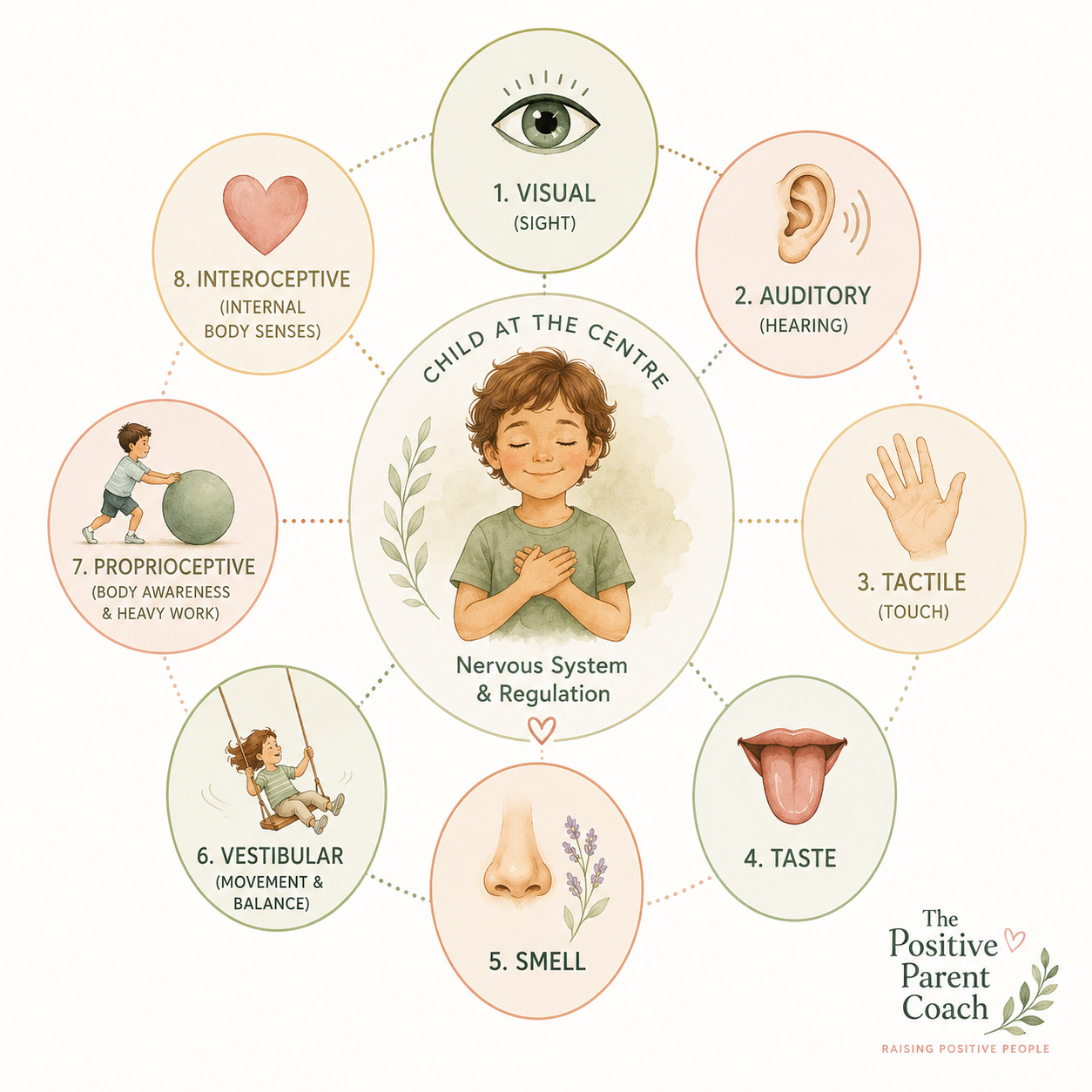
Understanding the 8 senses can transform the way we view our children's behaviour.
Instead of asking:
"Why are they behaving like this?"
we begin asking:
"What is their nervous system trying to tell me?"
What Are the 8 Senses?
Most of us grew up learning about the five senses:
Sight
Hearing
Touch
Taste
Smell
However, there are three additional sensory systems that play a huge role in emotional regulation, learning, attention, behaviour and wellbeing:
Vestibular Sense
The vestibular system helps us understand movement, balance and where our body is in space.
This system is activated through activities such as swinging, spinning, climbing, rocking and jumping.
Proprioceptive Sense
Often referred to as our "body awareness" system, proprioception helps us know where our body is and how much force we need to use.
Heavy work activities such as pushing, pulling, carrying, climbing and squeezing provide valuable proprioceptive input that many children find deeply regulating.
Interoceptive Sense
Interoception is our ability to notice what is happening inside our bodies.
It helps us recognise sensations such as hunger, thirst, tiredness, anxiety, excitement, tension and emotional states.
Many sensitive and deep-feeling children struggle to recognise these internal signals until they become overwhelming.

Why Understanding the 8 Senses Matters
Every moment of every day, our sensory systems are gathering information about the world around us.
When these systems feel supported and balanced, children are more likely to:
Regulate their emotions
Cope with challenges
Focus and learn
Make thoughtful choices
Feel connected and secure
When sensory needs are unmet, behaviour often becomes the language through which children communicate their discomfort.
This is why two children can experience the same situation but respond very differently. One child may shout, hit or become physically active. Another may withdraw, cry quietly, become highly self-critical or shut down completely.
Neither response is "bad behaviour." Both are nervous system responses.
Looking Beyond Behaviour
One of the biggest shifts we can make as parents is moving from behaviour management to behaviour understanding. When we focus solely on stopping behaviour, we often miss the message underneath it.
A child who is running around the room, climbing furniture and unable to sit still may not need stricter discipline. They may need movement.
A child who is arguing, shouting and becoming physically dysregulated may be seeking the sensory input their nervous system needs to feel organised and safe.
A child who appears anxious, withdrawn or emotionally fragile may be experiencing an overwhelmed nervous system that needs co-regulation and connection.

Deep Feeling Children and Sensory Needs
Many of the families I work with describe their children as sensitive, intense or deep feelers. These children often experience the world more deeply than their peers.
They notice subtle changes in tone.
They feel disappointment intensely.
They struggle with transitions.
They can become overwhelmed by sensory input, emotional experiences or perceived criticism.
For these children especially, understanding the sensory system can be transformative. What appears to be defiance may be overwhelm. What appears to be attention-seeking may be connection-seeking. What appears to be poor behaviour may actually be a child doing their best to regulate a nervous system that feels overloaded.
Supporting Regulation Through Connection
Children do not learn emotional regulation through punishment. They learn it through experience. They learn it through co-regulation. They learn it when calm adults help them borrow regulation during difficult moments.
This does not mean having no boundaries. It means understanding that regulation must come before reflection.
When a child is dysregulated, the thinking part of the brain is far less accessible. Correction, lectures and consequences are rarely effective in those moments.
Instead, children need:
Safety
Connection
Calm leadership
Nervous system support
Opportunities to regulate
Only then can meaningful learning take place.
Every Behaviour Is Communication
The visual accompanying this article places the child at the centre of the 8 sensory systems. This is intentional. Because every behaviour, emotion, reaction and response is influenced by how a child is experiencing the world through their senses.
When we begin viewing behaviour through a sensory and nervous system lens, we move away from asking:
"How do I stop this behaviour?" and towards: "What support does my child need right now?"
That shift changes everything.
It reduces shame.
It builds connection.
It strengthens emotional regulation.
And most importantly, it helps our children feel understood. Because when children feel safe, connected and supported, they are far more able to learn, grow and thrive.
Final Thoughts
Understanding the 8 senses gives us a powerful framework for making sense of children's behaviour.
It reminds us that behaviour is often communication, regulation is a skill that develops over time, and connection remains one of the most effective tools we have as parents.
The goal is not perfect behaviour.
The goal is helping our children develop the skills, awareness and resilience they need to navigate their emotions and the world around them with confidence.
Because every child deserves to be understood beneath their behaviour.
If you want to find out more about how to support your child and their whole sensory system send me an email and I can signpost you to the best support.