Consequences in Positive Parenting: The Difference Between Discipline and Punishment
One of the most common questions I hear from parents is:
“But if there isn’t a consequence, how will my child learn?”
Usually, this question comes after a difficult parenting moment. A child has lashed out at a sibling, shouted rudely, ignored repeated requests, or completely melted down emotionally. The parent is exhausted, overwhelmed, and carrying that familiar internal pressure that says:
You need to do something about this.
For many of us, consequences were a huge part of our own childhoods. If we behaved in ways adults didn’t like, something was taken away, we were punished, or we were made to feel bad enough that hopefully we wouldn’t repeat the behaviour again. Because of this, many parents understandably arrive in adulthood believing that consequences and punishment are essentially the same thing.
But in positive parenting and positive discipline, they are very different.
The goal of punishment is often control.
The goal of discipline is teaching.
That difference matters deeply because the way we respond to children’s behaviour shapes not only the lesson they learn in that moment, but also the long-term relationship they develop with us, with themselves, and with mistakes.
Why Punishment Often Backfires
Imagine a child who snatches a toy from their younger sibling and hits them when asked to give it back. The parent, already stressed and overstimulated, reacts quickly: “That’s it. No TV tonight.”
On the surface, this can look like a reasonable parenting response. The child behaved badly, so they receive a consequence. But if we slow the moment down and look underneath it, we can begin to ask a more important question:
What is the child actually learning here?
Often, children don’t walk away from punishments thinking: “I understand why my behaviour was wrong and I’d like to make a better choice next time.”
Instead, their nervous system becomes focused on:
Feeling shame
Feeling disconnected
Feeling angry
Feeling controlled
Or feeling misunderstood
This is particularly true for emotionally sensitive children or what I often refer to as deep feelers.
These children experience emotions intensely and are highly sensitive to judgement, criticism, or perceived rejection. When consequences feel emotionally loaded or shaming, deep feelers often move into defence rather than reflection. They may escalate, withdraw, blame others, or completely shut down.
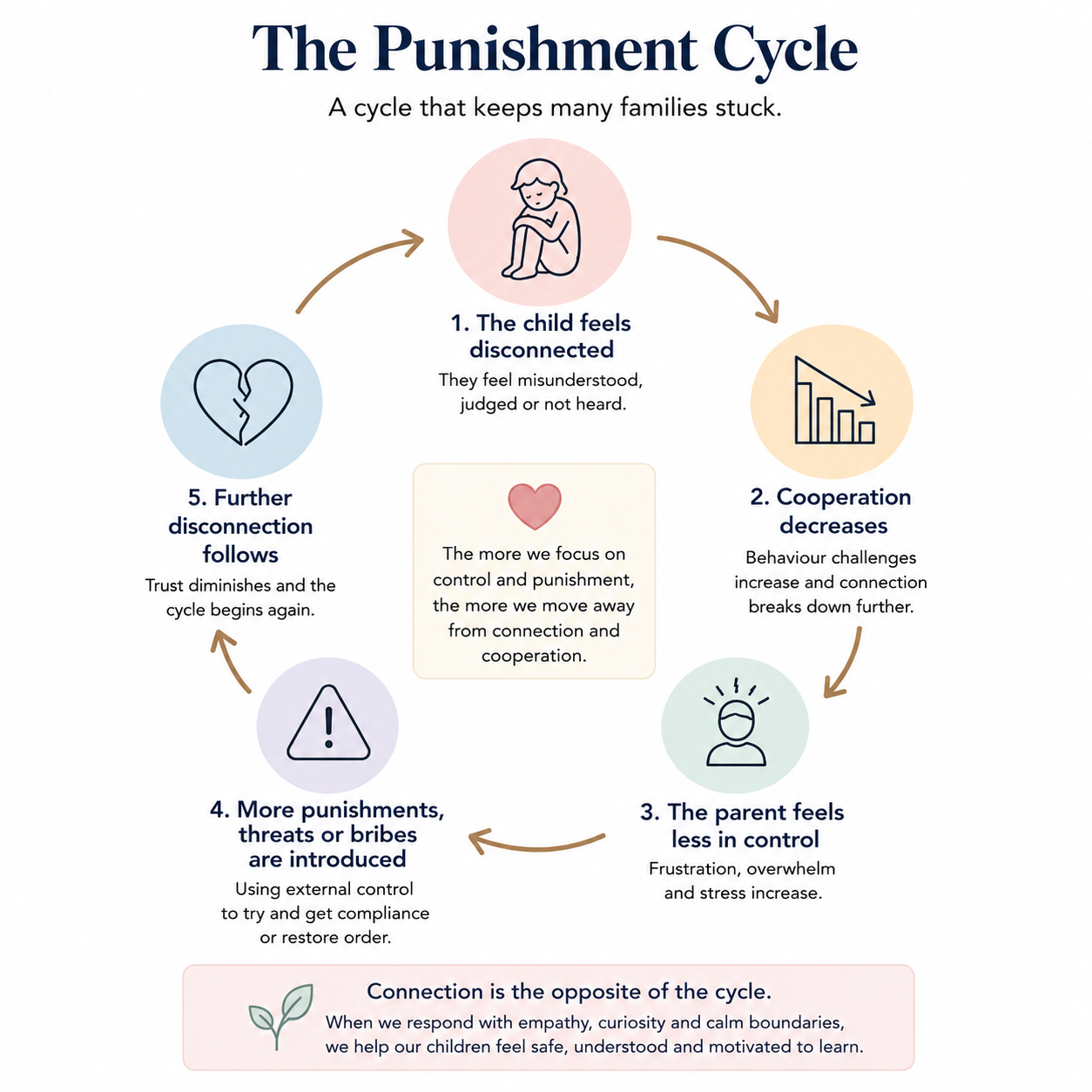
Parents then find themselves trapped in a negative parenting cycle:
The child feels disconnected → cooperation decreases → the parent feels less in control → more punishments, threats, or bribes are introduced → further disconnection follows.
Over time, children become externally motivated rather than internally guided. Instead of developing emotional regulation, empathy, and responsibility, they become focused on avoiding punishment.
Many parents come to me feeling completely stuck in a cycle they never intended to create…
Their child isn’t listening. Bedtimes become battles. Siblings are fighting. There is shouting, hitting, refusal, rude language, or complete emotional overwhelm. And despite desperately wanting to stay calm and connected, something rises up inside the parent in those moments too.
A voice that says:
“You can’t let them get away with this.”
“You need to be firmer.”
“You’re losing control.”
“Good parents wouldn’t allow this behaviour.”
So often, this is where punishment enters the picture.
Not because the parent is bad.
Not because they don’t love their child deeply.
But because their own nervous system has become activated, and they instinctively default to the parenting roadmap they were given themselves.
For many of us, consequences in childhood were heavily rooted in fear, shame, control, or emotional withdrawal. We were taught that children learn by feeling bad enough not to repeat the behaviour. So when our own child ignores us, lashes out, or pushes against a boundary, those old emotional roads become very easy to travel down again — especially when we’re exhausted, overwhelmed, touched out, or doubting ourselves.
This is why parenting can feel so triggering.
A parent might calmly start dinner time with the best intentions, but after asking their child to sit down for the fifth time while the baby is crying and everyone is hungry, they suddenly hear themselves saying:
“If you don’t sit down right now, there’ll be no dessert.”
Not because they truly believe removing dessert will teach emotional regulation, cooperation, or respect, but because in that moment they feel powerless, dysregulated, and desperate to regain some control.
And the heartbreaking thing is, punishment often does appear to work in the short term.
The child stops.
They comply.
The behaviour ends.
But underneath the surface, something else is happening too.
The child feels misunderstood, disconnected, or emotionally unsafe. Cooperation decreases because connection has weakened. The parent then feels even less effective and more out of control, so they increase the intensity — more threats, more punishments, more bribes, more shouting.
And slowly, families can find themselves trapped in a cycle neither side actually wants to be in.
This is where positive discipline offers something different.
Positive discipline is not permissive parenting. It is not the absence of boundaries or accountability. It is about understanding that children learn best through connection, emotional safety, co-regulation, and skill building, not fear.
A consequence within a positive discipline model is not designed to make a child suffer for a mistake. It is designed to support learning in a respectful and emotionally safe way.
Imagine a child repeatedly throwing blocks at their sibling. A punishment-based response might be: “That’s it. No pudding tonight.”
But deep down, the child doesn’t learn why the behaviour happened, what to do differently, or how to manage the emotions driving it. They simply experience disconnection and control.
A connected discipline approach sounds different: “I can’t let the blocks be thrown at people. I’m going to move them away for now.”
There is still a clear boundary. Safety is still being prioritised. But the child is not being shamed, rejected, or emotionally isolated.
This shift can feel incredibly unfamiliar for parents at first because it requires us to tolerate discomfort differently. It asks us to stay grounded when our child is dysregulated. It asks us to lead rather than control. And for many parents, that can feel deeply vulnerable.
Especially because true learning rarely happens in the heat of the moment.
When children are overwhelmed, angry, ashamed, frustrated, or emotionally flooded, their nervous system moves into survival mode. Their thinking brain becomes far less accessible. This means lectures, reasoning, punishments, or attempts to “teach a lesson” during a meltdown are often ineffective.
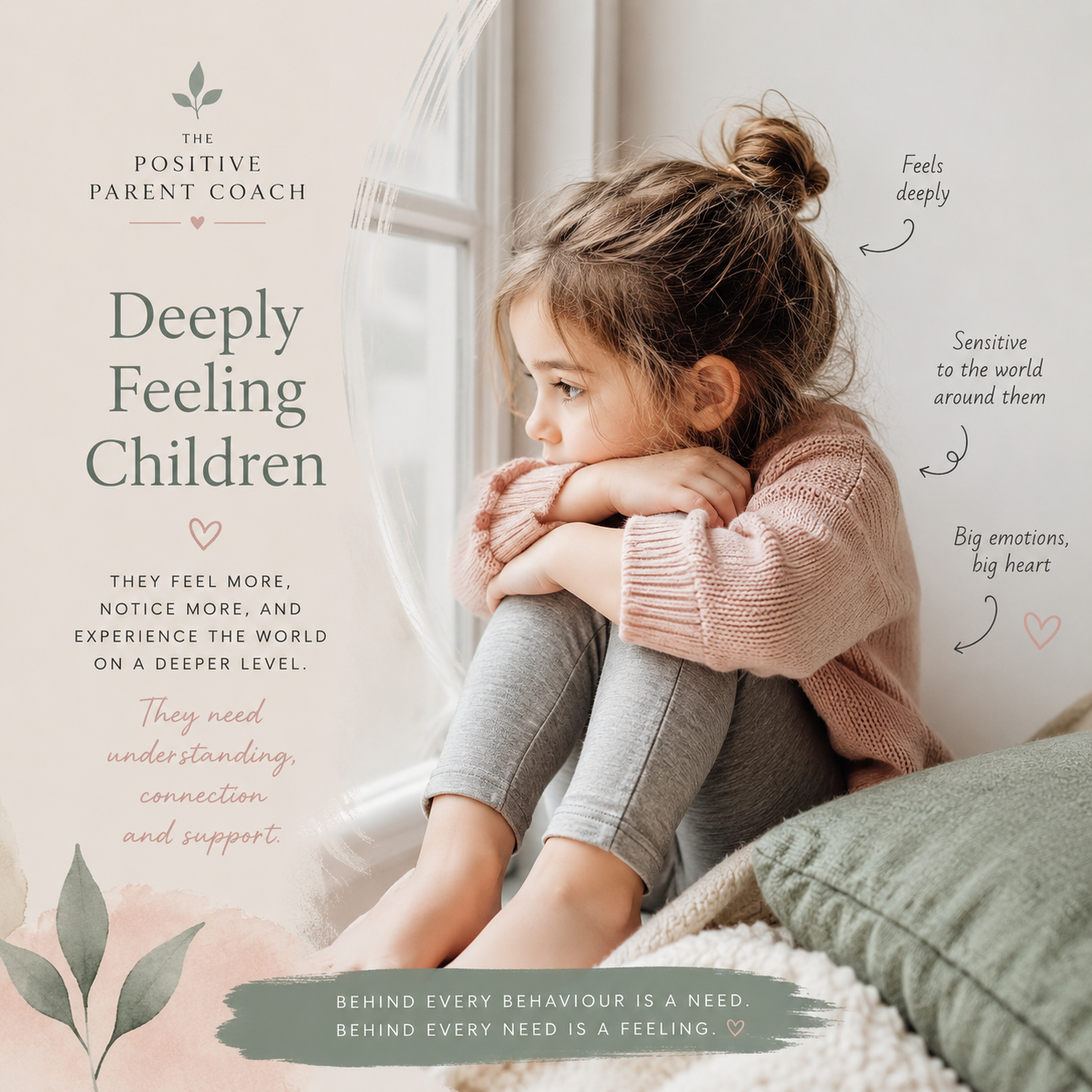
This is particularly important for emotionally sensitive children and deep feelers.
Deep feelers tend to experience emotions intensely. They are often highly perceptive, sensitive to shame, deeply affected by perceived criticism, and more likely to move into fight, flight, freeze, or collapse when overwhelmed. Traditional punishment can feel especially threatening to their nervous system, which is why many parents find consequences seem to “make things worse.”
Instead, these children often learn best through what I call “back door teaching.”
Rather than correcting them directly in moments of overwhelm, learning is introduced later through connection, curiosity, stories, play, humour, modelling, and reflection.
For example, imagine a child who screams and storms off every time they lose a game. In the moment, their body is flooded with frustration and vulnerability. Trying to lecture them about sportsmanship while they are dysregulated is unlikely to land.
But later, during a calm and connected moment, a parent might gently say: “I wonder why losing can feel so hard sometimes?” Or: “My body gets frustrated when things don’t go the way I hoped too.”
This feels safer. Less exposing. Less shaming.
And over time, these small moments build enormous long-term skills: emotional regulation, self-awareness, frustration tolerance, problem solving, empathy and resilience.
This is the work I support parents with every day.
Not simply changing behaviour on the surface, but helping parents understand why these cycles happen, what is being activated in them emotionally, and how to slowly re-wire their responses so they can parent from connection instead of survival.
Because the truth is, most parents already know what kind of parent they want to be.
The difficulty is accessing that version of themselves in the moments that feel hardest.
Through nervous-system aware parenting strategies, reflective work, emotional awareness, practical tools, and real-life implementation, I help parents move away from reactive, fear-based patterns and towards calmer, more collaborative relationships with their children.
And while this approach can feel slower initially, the long-term transformation is profound.
Children begin cooperating because they feel safe and connected, not because they fear punishment.
Parents feel more confident and regulated.
And family relationships begin to feel lighter, calmer, and more secure.
In my signature parenting programme, Lead with Confidence, we explore positive discipline in far greater depth — including the differences between discipline and punishment, the role of consequences, and how to support lasting behavioural change without relying on fear, shame, bribes, or threats.
Throughout the programme, I share evidence-based parenting research, real-life family scenarios, practical scripts, nervous-system aware tools, and specific strategies for raising deep feelers and emotionally sensitive children.
Every parent also receives a detailed resource booklet filled with guidance, reflective exercises, and practical tools designed to create meaningful long-term transformation within family life.
You can find out more about the next Lead with Confidence programme, starting in September, here:
Lead with Confidence Parenting Programme
And if you feel that you need help now, or something to help keep you on track then next month in The Positive Solutions Studio I’ll be delivering a webinar on How to support your child’s learning through consequences, and why they are different to punishments. If you want to sign up for the webinar, along with access to a monthly coaching call with me and all of my workshops and resources then get registered here.